AIRRUS - A SIMULATION OF THE A300 We wish it to be clearly understood that the simulations that we publish have one thing in common; namely, that they are EXACT simulations of the aircraft or space vehicle concerned in all ways we chose as it is possible to get, within the medium of a microprocessor. JUMBO is a precise engine of flying a T47, B437 full in an issue as one can get to flying a 300-500-3000m/s space craft and this new simulation, AIRRUS is a very precise simulation of flying the AIRRUS A300. Large aircraft, and space vehicles are flown on instruments not with instances in the outside world and in this family of simulations the majority of memory is devoted to instrument flying rather than graphic displays. The A300 was born in 1965. The first design proposals for it were put up to the British, French and German governments in October 1966. The pro-posed was involved in December of that year. The present A300 in use stems from a modified A300 A design proposal two years later in 1968 and the first A300 B-1 aircraft first took to the air on the 28th October 1972. As with all jet liners there have been a large number of modifications and new models. The original airframe partners were Aerompatiale, Hecker Siddeley and Deutsche AIRRUS plus Rolls Royce and two other companies for the power plants. Pakker and CAAX joined the program later. The model upon which AIRRUS is based is powered by two General Electric CRY-OCCF turbo fans, with a maximum seating of 320. The maximum all up take off weight is 140,000 kg. It is able to land and take off on a comparatively short runway ~ 5,600 feet - and has a maximum range, with a pay load of 30,000 kg., of 100 feet. The A300 is a two engine aircraft and this is particularly important to our simulation because it enables the inclusion of a random 'engine out' emergency situation. Although this can, and in future progress no doubt will, be incorporated in that engine aircraft, the complexities of such emergencies increase rather dramatically with the increase in the number of power plants. It would be advisable if we draw the distinction between JUMBO and AIRRUS, for a number of customers who have 'behind flying' an JUMBO will wish to purchase AIRRUS and obviously they would like to know the differences in the best way to describe them is to say that JUMBO is perhaps more of a fine ground than is AIRRUS. Once again we emphasize that they are both precise simulations of the flight of their respective aircraft but when John Taylor and Frank Avery wrote JUMBO, they deliberately kept out of it the complications of navigation; although all of the controls, 'touch', procedures and other matters regarding the actual flying of the aircraft are precise, the method of getting from A to B is not a true simulation. Pilots of JUMBO essentially travel from London to Birmingham by dual reckoning or by simply following a company loading. Thus the interest now pilots who purchase JUMBO (which was the first simulator in to the bottom of the main road) are to concentrate on the enjoyment of flying a boy who without overly concerning themselves with its navigation. In true life all large aircraft, and most small aircraft, travel about the world by means of radio navigation. These devices take a number of forms. The most commonly used is the VCR or Omni. In the approach phase, a beacon called the outer marker is used at all airports and finally next VCRs include a JMS which is an acronym for Distance Measuring Equipment. All of these aids are included in AIRRUS. One of the prime differences between JUMBO and AIRRUS is that the latter includes radio navigation facilities. The other main difference is rather difficult to describe because the air which to give the wrong impression. The author has taken an extremely detailed approach to the task of writing the program and documentation. Jan Ahrestigt is both by nationality and perhaps this accounts for the meticulous nature, and quantity of detail which he includes in both the program and documentation. If one puts these two factors together, the fact that radio navigation is included and the program has been written in particularly meticulous manner, one will understand that if AIRRUS is to be flown precisely according to the book, it will prove to be no mean achievement. We should make it absolutely clear that as a two original aircraft, AIRRUS is inherently easier to fly than JUMBO and if you wish to go up for a Sunday afternoon jaunt without worrying where you are going, then AIRRUS will be happy to oblig. Purchasers of JUMBO will know that the first part of their manual is educational, the second part is the actual T47 manual. As a number of AIRROD purchasers will already be JUMBO filers, we are not including the first educational part of the manual automatically. Any purchaser of AIRRUS, on payment of an extra $2.00, will be supplied with the educational manual. Otherwise the normal flying manual will be supplied as its own. AIRRUS is flown with the instrument panel on the screen at all times. This contains graphic representations of the following instruments: . (1) Indicated air speed gauge . (2) Artificial horizon . (3) Power setting for No. 1 engine . (4) Power setting for No. 2 engine . (5) Slat setting . (6) Flag setting . (7) Compare . (8) VCR tracking instrument Reported in normal text on the screens are: . (1) Clock . (2) All up weight . (3) Air . (4) Fuel flow . (5) Vertical speed indicator . (6) M6/2 speed . (7) Precise pitch . (8) Precise roll . (9) Altimeter . (10) Landing gear status . (11) Nose wheel status . (12) Wheel brakes status . (13) Air brakes status . (14) True air speed . (15) Wind direction and velocity . (16) Ground speed . (17) Destination runway place and number . (18) Distance to go . (19) Precise heading . (20) Precise track . (21) Data from No. 1 DMC/VCR . (22) Data from No. 2 DMC/VCR The controls listed in Section 3 of the manual are some 40 in number. Controls from the keyboard. Each one consists of a letter and isomap for the navigational controls: one of the directional arrows. Thus pressing the letter 'A' is not up arrow will result in the throttle being opened by 10%. Continuous application will cause the throttle to open in increments of 10% until full power is obtained. In a similar way, the aircraft is backed by pressing the 8 way pipe the right and the right, and the left arrow for left. In this case, the increments are 5 degrees. A fine adjustment is available for the throttle control, the pitch control and the nose wheel direction control. In each case the stop size is 1/5th of the normal. In the case of the throttle, increments will be 2% rather than 10%. As we mentioned, inherently AIRRUS is easier to fly than JUMBO. This ease of use has been taken further by the inclusion of a number of features. For instance the three speeds V.1, 9N and V.2 are all displayed on the instrument panel at the appropriate times. In actual life this does not happen as the co-glint is supposed to shut them out as they occur. To this extent the program supplies the AIRRUS pilot with a regular! Another size feature is that the runway is of a specific length. If you overrun it, as in real life, you will crash. The nose wheel is guidside and if you run the aircraft off the runway you will also crash a pause feature is included so that a new pilot can take time out to consider his position. AIRRUS is, in its computer simulation, a forgiving aircraft and we rather suspect that this may also be for in real life. For instance, we said just one that the runway was of a little length and that it was possible to run the plane off the end of it. This is true but one has to work pretty hard at it I knowing that the correct flag and slot extension (which is authentic in the program is left as it is, then the plane will pretty well fly itself off the runway. One also has to work quite hard at stalling NEEDS. It was most definitely he done but, they before the stall, the pilot gets a halfstring warning on the panel and even after that, one has to pretty well have to cause a stall before the aeroplane will fall out of the sky. An AIRRUS is a coupled Basic program its 000 compatibility will depend on that 000's compatibility with the Microsoft compiler. As customers will know, Microsoft never did produce a compiler for the Model III Ready, although most DOS's have patches available. On the Model III, much patches and much DOS's will have to be used. AIRRUS is a disk program only. In summary, AIRRUS is an extremely close simulation to flying the A300, featuring the use of navigational 6000 including the capability of using 2 VCR stations at one time. So long as the first part of the JUMBO manual is ordered at the same time, there is no reason why a customer, new to simulations, should not successfully fly AIRRUS, but it will be after a period of practice! Repr sentated JUMBO pilots should have little difficulty in flying AIRRUS, but they will have to take a little time to grasp the intricacies of radio aeroplane. Memory Requirement 32K 'DSS 80 Model 1 & 3 (See comments above re Mod.3 DOS )

(Meta-Technologies-Corporation)[M1].gif)
(Meta-Technologies-Corporation)[M1][h-RAF].gif)
(SofTrends)[M1].gif)
(Meta-.gif)
(SofTrends)[M3][Original][MD].gif)
(SofTrends)[M3].gif)
(SofTrends)[M1].gif)
(-)[M1][Hit-Key-To-Aim-Left].gif)

(Simutek-Ent)[M1].gif)
(Pasquale-M-Cirullo)[M4].gif)
(-)[M4][Enter-the-Estimated.gif)

(-)[M1][Cities-are-Listed-Alphabeti.gif)
(Pat-Roe)[M4].gif)
(Dwight-W-Meyer-Instant-Software)[M1].gif)
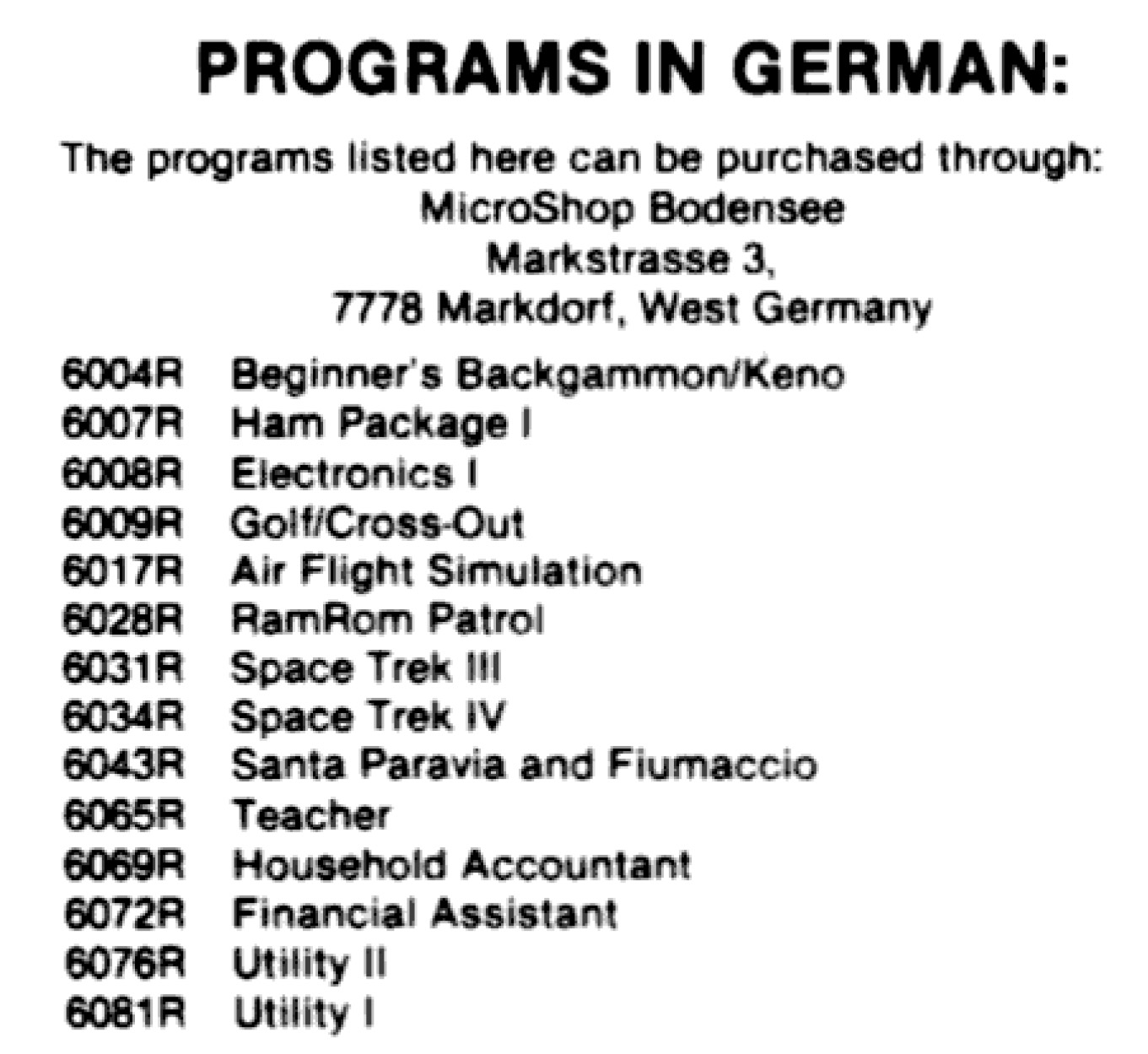
(Bob-Kozal)[M1].gif)
(Ward-P-Ferguson)[M1].gif)

(Small-System-Software)[M1].gif)
(William-Scott-Watson)[M1][Use-JKL-to-Fire-Missiles].gif)
(-)[M1][Your-Score-Misses.gif)
(Milan-Chepko)[M3].gif)
(Neal-P-Jensen)[M1].gif)
(W-D-MacDonald)[M1].gif)
(Dan-Keen-%26-Paul-Oves)[M1].gif)
(Charles-D-Baden)[M1].gif)
(Kevin-Copeland)[M1].gif)

(Molimerx-Ltd)[M1].gif)

(J-C-Sprott)[M1].gif)
(J-C-Sprott)[M1].gif)
(J-C-Sprott)[M4].gif)

(Richard-Kunc)[M4].gif)
(George-Schwenk)[AI140-0169][M1].gif)
(Norman-Goldsmith)[M4].gif)
(Instant-Software)[M1].gif)
(Bud-Baker)[M1].gif)

(-)[M1][1-Alphabetic-List-2-Distances-and-Bearing-3.gif)
(Paul-Rienholdtsen)[M1].gif)
(D-Longhurst-Molimerx-Ltd)[M1].gif)
(D-Longhurst-Molimerx-Ltd)[M1].gif)
(-)[M1][Correct-Time-Hour-Min].gif)
(-)[M1][Do-You-Want-to-Change].gif)
(-)[M4][Enter-Time-To-Alarm-At].gif)
(-)[M1][Enter-Time-To-Alarm-At].gif)
(Mark-J-Gustitis)[M4].gif)

(Joop-van-Dam)[M1].gif)
(Softside)[M1].gif)
(-)[M1][The-First-Part.gif)
(-)[M1][Ready-Printer].gif)
(-)[M1][Name-of-Locale].gif)
(-)[M1][Enter-Weight-in-Pounds].gif)
(Nick-Andrew)[M1].gif)
(Alcor-Systems)[M1].gif)
(Alcor-Systems)[M1].gif)
(Jack-Decker)[M4].gif)
(A-Johnson-Big-Al-Software)[M4].gif)